

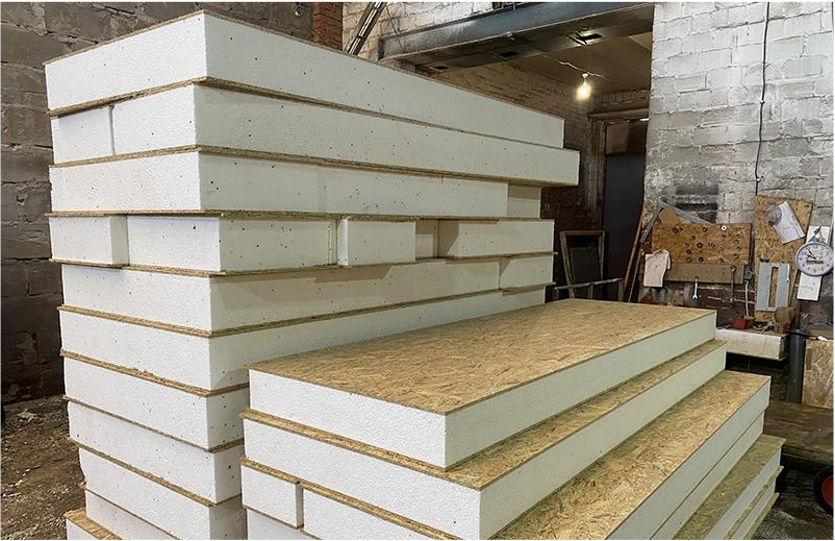
SIP panels (Structural Insulated Panels) are a modern construction technique that is gaining ground in private and professional construction. They are known for their excellent insulating properties, quick installation and environmental friendliness. However, there are also some points to consider. In this article, we discuss the advantages and disadvantages of building with SIP panels.
Advantages of SIP panels
- Excellent thermal insulation
SIP panels consist of an insulating core of foam (usually EPS or PUR) between two structural panels (usually OSB). This construction results in very high Rc values, which ensures low heating costs and a pleasant indoor climate, both in summer and winter.
- Fast construction time
Because SIP panels are prefabricated, a house can be built up to three times faster than with traditional construction methods. The “system thinking” approach ensures that wall, floor and roof elements are assembled directly on site, with minimal labour and time loss.
- High airtightness
SIP constructions have a minimal number of seams and joints, which drastically reduces heat loss through air leaks. This is an important feature for passive construction and energy-efficient homes.
- Lightweight but strong
Despite their low weight, SIP panels are structurally load-bearing. They can be used both horizontally and vertically and are resistant to wind and snow loads. This makes them popular in mountainous areas, in hard-to-reach locations or for adding extra storeys to existing buildings.
- Sustainable and environmentally friendly
Due to their high insulation value, SIP homes contribute to lower CO₂ emissions. In addition, there is less waste on site thanks to the prefabrication process. Some panels are even recyclable or made from recycled materials.
- Freedom in design
SIP is suitable for both simple and complex building designs. Modern architecture with sloping roofs, large windows and open floor plans can be perfectly combined with SIP technology.
Disadvantages of SIP panels
- Limited knowledge among contractors
Not all contractors in the United Kingdom are familiar with SIP construction. It is important to work with experienced professionals or specialised companies such as BOUWMALL, who know exactly how to process and finish SIP.
- Costs of customisation
Although construction time is shorter, SIP panels can seem more expensive to purchase than traditional materials. Production costs can be high, especially for very specific designs. However, this is often offset in the long term by energy savings.
- Limited on-site adaptation
Once produced, SIP panels are difficult to adapt on site. Every change must be carefully planned. This requires a detailed design and good communication with the manufacturer.
- Need for ventilation
Due to the high airtightness, a good ventilation system is essential to maintain a healthy indoor climate. A balanced ventilation or ventilation system with heat recovery (HR) is recommended.
- Dependent on weather and logistics
Although SIPs can be assembled quickly, assembly must be carefully planned, especially in wet or cold conditions. Panels must be delivered just-in-time to avoid damage or delays.